For greenhouse builders, EPC contractors, and agricultural system integrators, material selection is never just about transparency or cost. The real question is:
Will the glazing system remain safe, stable, and cost-efficient under real project conditions over 10+ years?
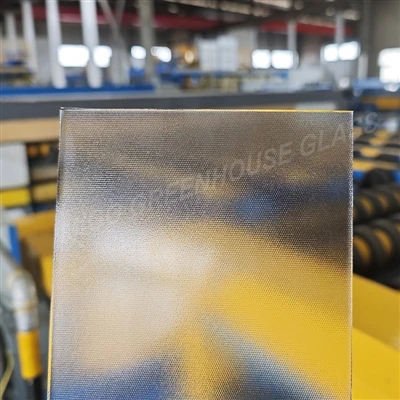
Clear tempered greenhouse glass is widely used in commercial agriculture because it is engineered not just for light transmission, but for structural reliability, lifecycle stability, and risk reduction in harsh environments.
1. How Does Clear Greenhouse Glass Reduce Structural Failure Risk in Real Projects?
In greenhouse engineering, unexpected glass failure is one of the most costly operational risks. It can lead to:
- Installation delays
- Crop damage from exposure
- Warranty disputes in EPC contracts
- Unplanned replacement logistics
Clear greenhouse glass addresses these risks through a tempering process designed for high mechanical stress environments.
Key engineering advantages include:
- Up to 25× higher impact resistance compared to standard annealed glass
- Strong resistance against installation handling stress and on-site mechanical impact
- Stable structural performance under repeated minor shocks
For greenhouse contractors, this translates into lower construction-phase failure risk and fewer site-level installation issues, especially in large-scale modular greenhouse projects.
2. Can It Withstand Hail, Wind Load Stress, and Agricultural Operation Damage?
In real agricultural environments, glazing materials are exposed to unpredictable external forces such as hailstorms, strong winds, and daily operational contact.
Clear tempered greenhouse glass is designed to perform under these conditions:
- Withstands hail impact (~1cm diameter) without structural breakage
- Resistant to accidental contact from tools, irrigation systems, and maintenance equipment
- Maintains integrity under long-term cyclical environmental stress
Compared with polycarbonate sheets or plastic film systems, glass does not suffer from:
- Surface deformation
- UV-induced weakening
- Progressive optical degradation
This is particularly important for commercial greenhouse projects in Europe, North America, and high-wind agricultural zones, where long-term structural stability is a procurement requirement, not a preference.
3. Is Temperature Stability Reliable Enough for Year-Round Agricultural Production?
Greenhouses operate under extreme thermal variation, especially in regions with seasonal or desert climates.
Clear greenhouse glass maintains stable performance in a working range of -20°C to 60°C, ensuring:
- Reduced risk of thermal expansion cracking
- Stable performance during freeze-thaw cycles
- Predictable behavior in high summer temperature conditions
For EPC contractors and greenhouse designers, this stability reduces:
- Structural recalculation needs
- Maintenance frequency in seasonal transitions
- Unexpected warranty claims related to thermal stress failure
This is especially relevant for controlled-environment agriculture (CEA), hydroponic farms, and high-density commercial planting systems, where environmental consistency directly impacts yield stability.
4. What Is the Real Lifecycle Cost Advantage Compared to Plastic Film Systems?
While initial procurement decisions often focus on unit price, professional greenhouse buyers evaluate total lifecycle cost (LCC).
From a project economics perspective:
- Clear greenhouse glass typically lasts 10+ years
- Plastic film systems require replacement every 12–24 months
- Each replacement cycle introduces labor cost, downtime, and crop disruption
When calculated over a 10-year project cycle, greenhouse glass provides:
- Lower total maintenance frequency
- Reduced operational interruption risk
- More stable long-term budgeting for facility operators
In many commercial greenhouse investment models, this results in a significantly lower cost per square meter per year, even if upfront investment is higher.
Additionally, glass is fully recyclable and does not create microplastic waste, which supports ESG-compliant agricultural infrastructure projects in regulated markets such as the EU.
5. Why Do EPC Contractors Prefer Glass in Large-Scale Greenhouse Projects?
For engineering procurement and construction (EPC) contractors, material consistency and installation predictability are critical.
Clear greenhouse glass supports:
- Stable dimensional accuracy for modular installation systems
- Custom cutting for greenhouse structural optimization
- Compatibility with aluminum framing systems and modern greenhouse structures
This reduces on-site installation deviation and improves alignment with:
- Project delivery timelines
- Engineering compliance requirements
- Long-term maintenance planning
As a result, glass is often selected for large commercial greenhouse facilities, export-oriented agricultural projects, and turnkey greenhouse systems.
6. What Does This Mean for Long-Term Greenhouse Investment Performance?
From an investment and operational standpoint, clear tempered greenhouse glass delivers three key outcomes:
1. Reduced structural risk
Fewer breakages and lower probability of catastrophic glazing failure.
2. Lower lifecycle cost
Less frequent replacement compared to film or lower-grade materials.
3. More stable agricultural output
Consistent light transmission and environmental stability over time.

Conclusion: A Structural Material Designed for Commercial Agriculture Reliability
Clear tempered greenhouse glass is not simply a covering material-it is a long-term structural component of commercial greenhouse systems.
It is most suitable for:
- Commercial greenhouse builders
- EPC contractors and system integrators
- Controlled-environment agriculture (CEA) projects
- Large-scale horticulture production facilities
For B2B buyers, the decision is not about "glass vs. alternatives" alone, but about:
Which glazing system minimizes lifecycle risk while maximizing long-term operational stability and ROI?
In this context, clear greenhouse glass remains one of the most reliable and widely adopted solutions for modern greenhouse engineering projects worldwide.