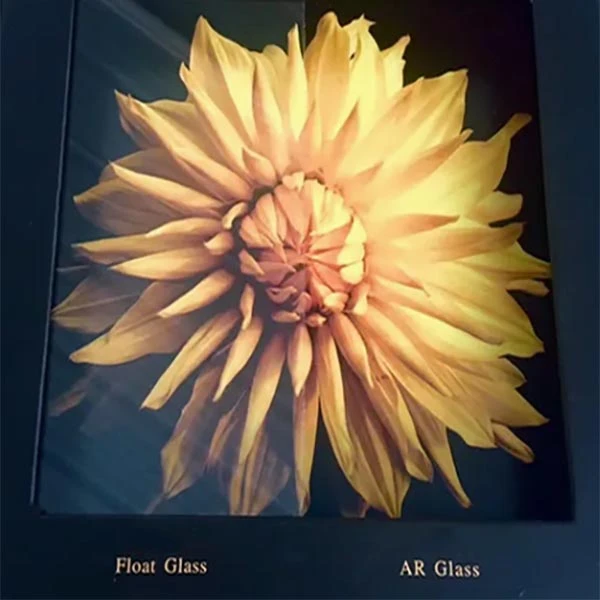
Anti-reflective (AR) coating is widely used on solar glass to reduce surface reflection and improve light transmission into photovoltaic modules. For PV module manufacturers, however, specifying AR-coated glass is only the first step. The uniformity of the coating across individual sheets and production batches is also an important quality consideration.
For buyers sourcing AR-coated solar glass in bulk, coating consistency should be evaluated together with base glass quality, solar transmittance, appearance, and long-term production stability.
What Is AR Coating on Solar Glass?
When sunlight reaches the surface of solar glass, part of the incoming light is reflected rather than transmitted through the glass.
An anti-reflective coating is applied to the glass surface to reduce this reflection. By allowing more light to pass through the cover glass, the coating can support the optical performance required by modern PV modules.
The final result depends not only on whether an AR coating is present, but also on how consistently it is produced.
Why Coating Uniformity Matters
AR coating should provide controlled optical characteristics across the usable surface of the glass.
If the coating varies significantly from one area to another, optical performance and visual appearance may also become inconsistent. For PV module manufacturers operating automated production lines, material consistency is particularly important because large quantities of glass are processed continuously.
Uniform coating helps manufacturers maintain predictable incoming-material characteristics across the production batch.
Base Glass Quality Still Matters
AR coating cannot be evaluated independently from the solar glass underneath it.
Low-iron solar glass is commonly used because reduced iron content helps limit absorption within the glass. Surface pattern, glass thickness, composition, and manufacturing quality can also influence optical performance.
This means that buyers should evaluate the combination of low-iron base glass and AR coating, rather than focusing only on a single coated-glass transmittance value.
For high-efficiency PV modules, controlling both parts of the product becomes increasingly important.
Coating Process Can Affect Consistency
AR coating performance depends on controlled manufacturing conditions.
Coating preparation, application parameters, curing conditions, glass surface cleanliness, and other process factors can influence the finished product.
For large orders, buyers should pay attention to whether the supplier can maintain stable coating characteristics across different production batches.
This is especially important for PV module manufacturers with continuous supply programs where solar glass may be delivered over several months.
Visual Inspection Is Also Important
In addition to optical testing, coated solar glass should be inspected for visible coating irregularities according to the agreed quality standard.
Depending on the product and inspection conditions, buyers may check for obvious uneven areas, contamination, scratches, stains, or other surface defects.
Visual inspection should follow defined criteria rather than subjective judgment alone. The supplier and buyer should agree on the inspection method before mass production whenever appearance requirements are important.
AR Coating and Glass Handling
The coated surface also needs appropriate handling during packaging, transportation, storage, and PV module production.
Improper contact, contamination, or unsuitable handling methods can affect the glass surface before module assembly.
PV manufacturers should therefore identify the coated side correctly and follow the handling and storage recommendations specified for the product.
For international orders, export packaging should also be designed to protect the solar glass surfaces during container transportation.
What Should Buyers Check Before Ordering?
When purchasing AR-coated solar glass, buyers should review more than the nominal transmittance value.
Important considerations can include the base glass specification, iron content, glass thickness, surface pattern, AR coating requirements, optical performance, dimensional tolerances, and applicable inspection criteria.
For bulk orders, buyers should also consider batch-to-batch consistency and request relevant technical documentation according to their quality-control requirements.
Samples can be evaluated before mass production when a new solar glass specification is being introduced into a PV module design.
Evaluating AR-Coated Solar Glass as a Complete Product
AR coating is an important part of high-transmittance solar glass, but its performance depends on the complete glass system.
The quality of the low-iron base glass, surface structure, coating process, tempering, and production control all contribute to the characteristics of the finished product.
For PV module manufacturers sourcing solar glass in bulk, consistent AR coating can help maintain stable optical specifications across continuous production.
Rather than comparing suppliers only by a single transmittance figure, buyers should evaluate coating uniformity, base glass quality, testing methods, and batch consistency together when selecting AR-coated solar glass for photovoltaic module manufacturing.