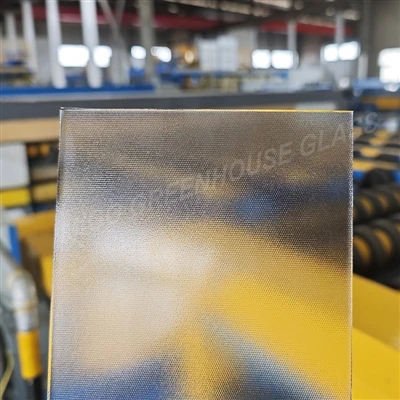
When evaluating greenhouse glass, Vertical LT and Hemispherical LT describe different optical conditions and answer different questions about light performance.
1. Vertical LT: Controlled Laboratory Condition
Vertical LT (Light Transmission) measures visible light transmission with light entering the glass at a fixed, near-vertical angle. In laboratory testing, this condition is highly controlled and repeatable.
For example, a Diffused greenhouse glass may show:
Vertical LT = 91%
This means that under a perpendicular light beam, 91% of visible light passes through the glass.
Vertical LT is useful because it allows:
Easy comparison between different glass products
Standardized quality control
Clear reference values in technical datasheets
However, it represents only a single incidence angle, which is not how sunlight behaves in real greenhouse environments.
2. Hemispherical LT: Real Solar Environment
Hemispherical LT measures light transmission across a wide range of incident angles, simulating the full hemisphere of daylight conditions.
In reality, sunlight:
Changes angle throughout the day
Varies with seasons
Enters the greenhouse from multiple directions due to scattering in the atmosphere
Because of this, Hemispherical LT is generally lower than Vertical LT. For example:
Vertical LT = 91% → Hemispherical LT = 82%
This difference occurs because at oblique angles:
Reflection increases at the glass surface
Internal scattering becomes more complex
Diffusion structures redirect part of the light away from direct transmission
3. Why the Difference Matters
The key point is not that one value is "better" or "worse", but that they describe different optical realities:
Vertical LT = idealized, single-angle performance
Hemispherical LT = integrated, real-world solar performance
For greenhouse design, Hemispherical LT is often more relevant because it better reflects the actual amount of usable light entering the crop environment over time.
4. Special Importance for Diffused Glass
The difference between these two values becomes more significant in Diffused or Patterned Greenhouse Glass.
The embossed or textured surface is designed to:
Scatter incoming light
Reduce direct beam intensity
Improve light distribution within the canopy
However, this structure also means that optical behavior is highly angle-dependent. As a result:
Vertical LT may appear relatively high
Hemispherical LT may decrease more noticeably
This is not a defect, but a functional characteristic of diffusion design.
5. A More Complete Evaluation: LT + Haze + Hemispherical LT
To properly evaluate greenhouse glass performance, a single number is not sufficient. A more complete optical profile includes:
Vertical LT → laboratory reference value
Hemispherical LT → real-world light transmission
Haze → degree of light diffusion and scattering
Together, these parameters describe both:
Light quantity (how much light enters)
Light quality (how light is distributed inside the greenhouse)
Conclusion
Vertical LT = fixed-angle laboratory performance
Hemispherical LT = multi-angle, real-world solar performance
For modern greenhouse applications-especially in high-performance diffused glass systems-Hemispherical LT is often the more representative indicator of actual growing conditions, while Vertical LT remains essential for standardized comparison.