How Does Haze Affect in Greenhouse?
In greenhouse cultivation, glass is not only a structural material but also an important component for controlling the indoor light environment. For diffused glass in greenhouse, haze is a key optical parameter that directly affects light distribution, crop photosynthesis, and the overall growing environment. Understanding the relationship between haze and light transmission is essential when selecting the right greenhouse glass.
1. What Is Haze in Greenhouse Patterned Glass?
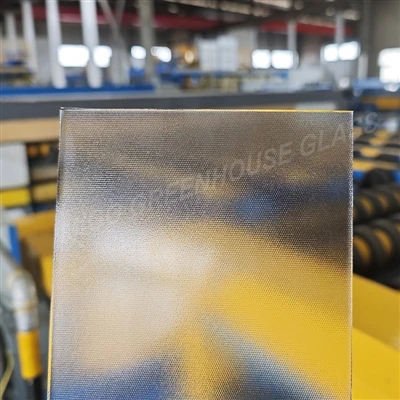
Haze refers to the percentage of transmitted light that is scattered rather than passing directly through the glass. Patterned glass naturally creates light scattering because its textured surface changes the direction of transmitted light.
Compared with standard float glass, patterned glass can provide a higher level of diffuse light, helping distribute sunlight more evenly throughout the greenhouse.
2. How Does Haze Affect Light Distribution?
A higher haze value generally means stronger light scattering. Instead of allowing sunlight to concentrate in a limited area, the glass disperses light in multiple directions.
This can improve light uniformity inside the greenhouse. For crops with dense canopies, appropriate haze can help distribute light deeper into the plant canopy, allowing middle and lower leaves to receive more usable light.
3. Higher Haze Does Not Always Mean Better Performance
It is important to understand that higher haze is not necessarily better. Excessive light scattering may reduce the amount of direct light reaching the crop and can affect overall light transmittance.
Therefore, greenhouse glass should not be selected based on haze alone. A proper evaluation should consider light transmittance, haze, diffuse light ratio, solar radiation, and crop light requirements together.
4. Haze and Crop Growth
Appropriate haze can create a more balanced greenhouse light environment. By reducing concentrated direct sunlight and increasing diffuse light, it may help minimize localized excessive radiation and improve light penetration into the crop canopy.
For high-value crops such as tomatoes, cucumbers, and strawberries, a more uniform light environment can contribute to better canopy light utilization and more consistent crop development.
5. How to Choose the Right Haze Level?
The optimal haze level depends on the crop type, greenhouse structure, geographic location, solar radiation conditions, and ventilation system.
When selecting patterned greenhouse glass, buyers should evaluate glass thickness, surface pattern, light transmittance, haze, and diffuse light performance as a complete optical system rather than focusing on one parameter.
The role of haze in greenhouse patterned glass is essentially about finding the right balance between light transmission and light diffusion. The goal is not to achieve the highest possible haze, but to ensure that sufficient usable light reaches the crop canopy in a more uniform way.