Solar glass may appear to be a fairly basic product-a clear sheet of glass only a few millimetres thick. In practice, selecting glass for a PV module involves more than comparing dimensions and prices.
Since the glass covers the solar cells, all incoming sunlight has to travel through it. Any light absorbed or reflected by the glass cannot be used by the cells. The glass also forms the module's first line of protection against rain, wind, hail and changing outdoor temperatures.
Why Solar Glass Uses Low-Iron Raw Materials
The green color visible along the edge of standard clear glass comes largely from iron oxide in the glass composition.
This slight color is not usually a concern for architectural use. In a solar module, however, the iron content reduces the amount of light reaching the cells. Low-iron glass is used to limit this loss and provide better light transmission.
It is easy to focus on the highest figure shown on a data sheet, but we normally suggest looking at production stability as well. One sample may have excellent transmittance, while the actual order may include several production batches. The results should remain reasonably consistent throughout the order.
When comparing reports from different suppliers, make sure the samples have the same thickness, pattern and coating. Otherwise, the transmittance figures do not provide a fair comparison.
What Is the Pattern For?
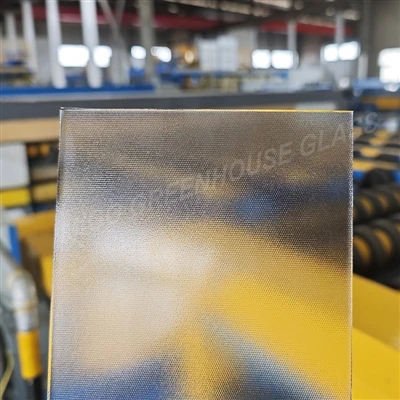
The patterned surface of solar glass is created during rolling. Its main purpose is to reduce reflection and help more light enter the module.
There are different pattern designs on the market. A deeper or more complicated pattern does not automatically give better performance. The result depends on the complete design, including the pattern shape, glass thickness and AR coating.
The pattern also needs to be even. If it changes across the sheet, or differs between batches, the finished modules may not have the same appearance. This is particularly noticeable when many modules are installed together.
A Note About AR Coating
For projects requiring better light transmission, an anti-reflective coating can be added to the glass. The coating limits reflection at the surface, leaving more sunlight available for the cells.
Do not judge an AR coating only by the transmittance recorded when the glass is new. Once the modules are outdoors, their surfaces have to cope with strong sunlight, moisture, dust, regular cleaning and temperature changes. The coating should remain firmly bonded to the glass without losing its optical performance too quickly.
Coating uniformity also matters. If the coating is uneven, differences in color or reflection may appear on the module. This may not be obvious when checking one sheet inside a factory, but it can be easy to see on a completed solar project.
Tempering Thin Solar Glass
Most solar glass is heat-treated before it is used in a module. The added strength helps the glass deal with handling and installation, as well as wind, snow, hail and temperature differences once the module is in service.
Tempering should not be viewed as an isolated stage. The quality of the original sheet, the condition of its edges and the way it is heated and cooled all influence the finished glass. A good furnace cannot remove a chip or crack that was already created during cutting.
Thinner glass leaves less room for variation during production. While 3.2 mm glass remains common, 2.0 mm and 2.5 mm glass are now frequently used in glass-glass modules where overall module weight is a concern.
Processing thinner glass calls for closer furnace control and gentler handling throughout the factory. It can be tempered reliably, but it cannot be treated in exactly the same way as thicker glass.
Is Thinner Glass Always Better?
There is no thickness that works for every module.
Using thinner glass can make a double-glass module lighter and easier to transport or install. The trade-off is that thin sheets are less forgiving during cutting, tempering, packing and handling. Bow, edge condition and packing pressure all require closer control.
The choice usually depends on the module size, structure, installation method and required mechanical-load performance. It should be decided together with the overall module design rather than based only on the cost per square metre.
In actual production, details such as dimensional tolerance, squareness and flatness can be just as important as transmittance. Excessive bow may cause trouble during lamination. Inaccurate sizes can interrupt an automated production line. Poor edges increase the risk of breakage when the glass is moved or loaded.
Do Not Forget the Packaging
Solar glass may pass factory inspection and still arrive damaged if it is not packed correctly.
Before reaching the customer, the glass goes through loading, port handling, sea transportation and inland delivery. Each stage creates movement and vibration inside the container.
Thin glass needs to be fixed securely, but excessive pressure can also cause damage. The wooden case, cushioning materials, straps and loading arrangement should match the glass thickness and dimensions. Proper packing is part of the product, especially for export orders.
Transmittance and price are only the starting points when reviewing an offer. Thickness tolerance, flatness, edge condition, coating performance and export packing are also worth confirming. From our experience, these practical details are often the ones that cause difficulties on the module production line.
MIGO GLASS produces low-iron patterned glass for photovoltaic modules. We offer different thicknesses and can also supply tempered or AR-coated glass according to the module design. For a quotation, please share the required dimensions, thickness, quantity and coating specification with our team.
Please find more information about Solar Glass Solusion here!!