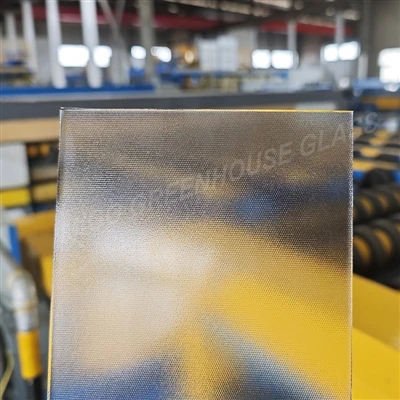
An overview of Prismatic/Matt (PM) patterned glass-commonly referred to as textured, woven, or high-transmission solar glass-and its status as the mainstream standard for crystalline silicon PV modules and solar thermal applications:
1. Light Trapping & Secondary Refraction: Boosting Optical Transmittance
Standard smooth float glass loses approximately 4% to 5% of incoming sunlight directly to surface reflection.
Secondary Refraction Mechanism: When sunlight hits the micro-prismatic/matt surface of patterned glass, a significant portion of the reflected light strikes adjacent microscopic structures instead of escaping. This "secondary refraction" forces the light back into the glass, boosting overall light transmittance by 1.5% to 2.0%.
Total Internal Reflection (TIR): After entering the glass, the micro-patterns redirect the angle of the light rays. When light reaches the interface between the glass and the encapsulant (EVA/POE), it is far more likely to undergo Total Internal Reflection, trapping the light within the module structure and maximizing absorption by the solar cells.
2. Optimized Incident Angle Modifier (IAM): Extending Daily Generation
The angle of sunlight continuously shifts throughout the day.
Low-Angle Light Capture: During early mornings, late afternoons, or overcast conditions, sunlight hits the glass at a sharp angle. Traditional smooth float glass experiences a sharp spike in reflection losses under these conditions.
Enhanced IAM: The multi-angled micro-facets of PM patterned glass significantly improve the module's Incident Angle Modifier (IAM). This allows off-center, low-angle sunlight to refract efficiently into the cells, extending the module's peak generation window every day.
3. Light Diffusion & Anti-Glare: Safety and Thermal Management
Anti-Glare Properties: The textured surface converts harsh direct sunlight into diffuse light. This eliminates blinding mirror-like glare, making PM glass the ideal choice for projects near airports, urban distributed rooftops, and floating PV installations.
Hot-Spot Reduction: Diffuse light scatters solar radiation evenly across the surface of the solar cells, minimizing localized overheating and reducing the long-term risk of hot-spot degradation.
Technical Comparison: Solar Patterned Glass vs. Smooth Float Glass
Direct Light Transmittance: Higher in Patterned Glass (+1.5% to 2.0% power gain); slightly lower in Float Glass (~4.5% reflection loss).
Low-Angle Light Capture: Superior in Patterned Glass (excellent morning/evening absorption); Poor in Float Glass (high low-angle reflection).
Anti-Glare & Diffusion: Excellent in Patterned Glass (diffused light distribution); Low in Float Glass (specular/mirror reflection).
Laminated Mechanical Reliability: Equal Performance. After thermal tempering and polymer lamination (EVA/POE), both glass types easily meet IEC 61215 standards, withstanding standard wind loads (2400 Pa) and snow loads (5400 Pa) with identical structural integrity.