A Technical Perspective for High-Performance Greenhouse Design
In modern controlled-environment agriculture (CEA), greenhouse glazing selection is no longer defined by transparency alone. The balance between light transmission and light diffusion directly determines crop productivity, climate stability, and energy efficiency.
At MIGO GLASS, this balance is engineered through advanced anti-reflective (AR) coatings, high-haze diffusion technology, and Low-E integration, enabling growers to optimize both light quantity and light quality.
1. Key Optical Definitions
Light Transmission (PAR Transmission)
Light transmission refers to the proportion of incident photosynthetically active radiation (PAR, 400–700 nm) that passes through the glazing system.
Conventional clear float glass: 88–91%
MIGO GLASS AR-coated diffuse glass: up to 93–96%
High transmission ensures maximum solar energy input - a critical factor in low-light regions such as Northern Europe, Canada, and the UK greenhouse market.
Light Diffusion (Haze Factor)
Light diffusion describes how transmitted light is angularly redistributed.
Expressed as haze (%)
Clear glass: < 5%
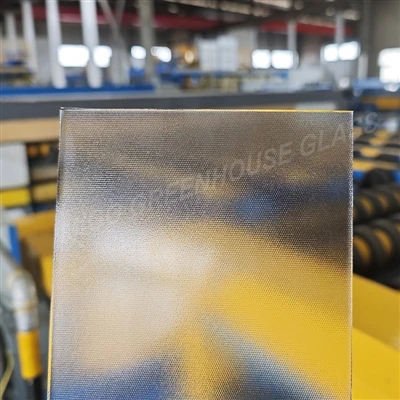
High-performance diffuse glass: 70–85%+
A high haze factor converts direct beam radiation into a uniform hemispherical light field, improving canopy penetration and spatial light distribution.
2. Why Transmission Alone Is Not Enough
Traditional greenhouse design prioritized maximum transmission under the assumption that "more light = higher yield." However, field data shows that light distribution efficiency is equally critical.
Under standard clear glass, direct (specular) radiation creates several systemic limitations:
2.1 Photosaturation in Upper Canopy
Top leaves frequently exceed the light saturation point (LSP) (~600–900 µmol·m⁻²·s⁻¹):
Excess photons do not increase photosynthesis
Energy is dissipated via non-photochemical quenching (NPQ)
Leads to thermal stress and reduced efficiency
2.2 Sub-Canopy Light Deficiency
Middle and lower leaves operate below optimal photosynthetic levels
Reduced whole-plant carbon assimilation
Lower radiation-use efficiency (RUE)
2.3 Thermal Hotspots & VPD Instability
Direct radiation increases leaf temperature
Raises vapor pressure deficit (VPD)
Triggers stomatal closure → reduced CO₂ uptake
2.4 Structural Shading Losses
Rafters, gutters, and frames create high-contrast shadow bands
Rapid light fluctuation reduces photosynthetic stability
3. How Diffuse Glass Improves Greenhouse Performance
Advanced diffuse greenhouse glass from MIGO GLASS fundamentally restructures the internal light environment.
3.1 Uniform Light Distribution
Diffuse light penetrates deeper into the canopy:
Improves vertical and horizontal light uniformity
Increases canopy light interception by 7–12% (industry data)
3.2 Higher Photosynthetic Efficiency
By redistributing photons:
Reduces top-leaf saturation
Enhances productivity of shaded leaves
Maximizes operation within the linear region of the PI curve
Result: improved whole-plant RUE
3.3 Reduced Shadow Contrast
Light wraps around structural elements
Minimizes sharp shading transitions
Creates a more stable growing environment
3.4 Improved Thermal Behavior
Compared to direct radiation:
Lower peak leaf temperature
Reduced transpiration stress
More stable stomatal conductance
Sustained CO₂ assimilation during peak radiation hours
4. Measurable Agronomic Impact
Commercial greenhouse trials (especially in Dutch and Northern European high-tech greenhouse systems) confirm:
+5–10% increase in dry matter production (e.g., tomatoes)
Higher yield consistency
Improved crop uniformity
These gains are driven not by increased total light input, but by optimized light distribution and utilization efficiency.
5. Integrated Performance: Beyond Optics
Modern greenhouse glass must address both optical and thermal performance:
High PAR transmission (AR coating)
High diffusion (engineered haze)
Reduced NIR transmission (heat control)
Low emissivity (Low-E coating)
MIGO GLASS greenhouse solutions integrate these features into a single system, delivering:
- Improved crop yield
- Reduced cooling and heating loads
- Enhanced ROI for greenhouse investors
6. Conclusion
The transition from clear glass to high-performance diffuse glass represents a shift from maximum light input → maximum light efficiency.

For greenhouse developers, contractors, and growers, the decision is no longer whether to use diffuse glass - but how to optimize haze, transmission, and coating technology for specific crops and climate zones.
As production technology advances and costs continue to decrease, diffuse AR-coated greenhouse glass is rapidly becoming the global standard in professional horticulture.