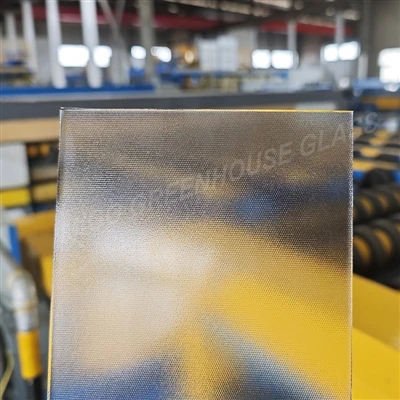
When sourcing Low-Iron Prismatic Matt Glass for high-efficiency solar modules, CSP systems, or commercial greenhouses, technical procurement often hits a practical roadblock: pattern verification. The microscopic textures that dictate light transmittance and haze parameters are notoriously difficult to capture via smartphone cameras, frequently appearing as a blurry, reflective surface.
For top-tier EPC engineers and greenhouse specialists, relying on unverified macro photos is a financial gamble. Misidentifying the surface geometry directly impacts daily energy yields and crop photosynthesis.
To bridge this gap, industry leaders utilize a simple, low-cost optical diagnostic: The Laser Transmission Method.
By projecting a coherent green laser beam through a glass sample onto a flat surface, the microscopic texturing acts as a lens array, revealing the exact geometric footprint through light diffraction:
Standard 4-Corner Grid: Projects a sharp, symmetrical four-corner star. While functional for basic vertical transmittance, its efficiency can fluctuate as the sun's angle shifts throughout the day.
Premium 6-Corner Omnidirectional Network: Projects a dense, hexagonal honeycomb pattern. This isotropic texture excels at capturing low-angle ambient light, maximizing continuous power output for solar tracking and scattering soft, diffuse light deep into greenhouse plant canopies to prevent localized leaf burn.
At Migo Glass, transparency is as vital as optical purity. If you are currently auditing incoming samples and need clear geometric verification, step away from the camera. Grab a standard laser pointer, run the transmission test, and let the data guide your ROI.
Connect with our engineering team for certified technical datasheets and sample kits.