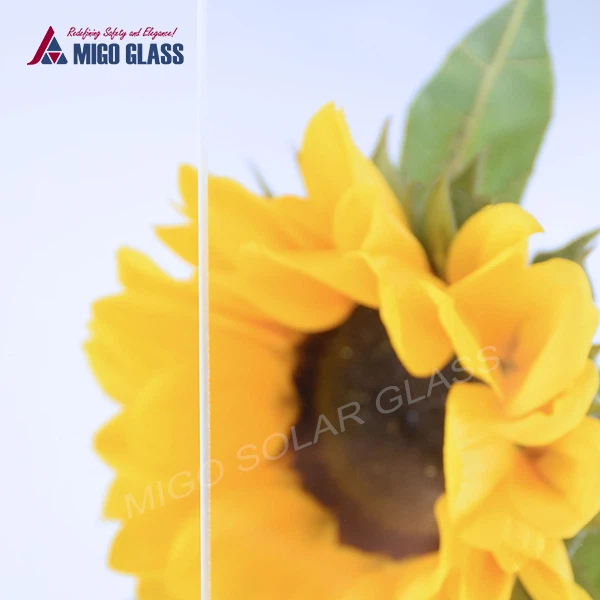
Glass may look like a simple protective layer, but in photovoltaic modules, its optical performance can directly influence how much sunlight reaches the solar cells. This is why low-iron solar glass is widely used for PV modules instead of conventional standard float glass.
For module manufacturers and solar glass buyers, understanding the difference between these two materials is important when evaluating performance, cost, and long-term application.
What Is Low-Iron Solar Glass?
Low-iron solar glass is manufactured using raw materials with a lower iron content than standard float glass.
Iron impurities give ordinary glass its slight green tint and absorb part of the incoming solar energy. By reducing the iron content, solar glass can achieve higher solar transmittance, allowing more sunlight to reach the photovoltaic cells.
This makes low-iron glass particularly suitable for high-efficiency solar modules, where reducing optical loss is important.
How Is Standard Float Glass Different?
Standard float glass is widely used in windows, doors, facades, and other architectural applications. It provides good transparency and mechanical performance at a competitive cost.
However, it is not specifically optimized for photovoltaic applications.
The higher iron content means more solar energy is absorbed by the glass before reaching the cells. For normal architectural applications, this difference may not be important. For a PV module expected to generate electricity for decades, however, optical performance becomes a much more important consideration.
Key Technical Differences
| Feature | Low-Iron Solar Glass | Standard Float Glass |
|---|---|---|
| Iron Content | Lower | Higher |
| Green Tint | Minimal | More noticeable |
| Solar Transmittance | Higher | Lower |
| AR Coating | Commonly available | Less common for PV |
| Surface Options | Textured or patterned options | Usually smooth |
| Main Application | PV modules | Architectural glass |
| Cost | Generally higher | Generally lower |
Why Solar Transmittance Matters
For PV manufacturers, solar transmittance is more important than simply how clear the glass looks.
Higher-transmission glass allows more usable solar radiation to pass through to the cells. Low-iron solar glass can also be combined with anti-reflective (AR) coatings to reduce reflection losses at the glass surface.
For high-efficiency module production, these optical improvements can contribute to better overall module performance.
However, buyers should also check whether the transmission and coating performance remain consistent between production batches.
Mechanical Performance Should Not Be Ignored
Optical performance is only part of the specification.
Solar glass must withstand years of outdoor exposure, including wind, snow, temperature changes, humidity, transportation, and installation loads.
Professional buyers should therefore evaluate:
- Tempering quality
- Thickness tolerance
- Glass flatness
- Edge quality
- Surface consistency
- AR coating durability
- Batch-to-batch optical consistency
A glass product with excellent initial transmittance but unstable manufacturing quality can create problems during module production.
Which One Should PV Manufacturers Choose?
For most conventional photovoltaic modules, low-iron solar glass is the preferred option because it is specifically designed to improve light transmission while providing the mechanical protection required by the module.
Standard float glass remains suitable for many architectural and general industrial applications, but its optical properties are generally less optimized for solar energy conversion.
For buyers, the decision should not be based on glass appearance alone. Solar transmittance, coating performance, mechanical strength, dimensional consistency, and long-term durability should all be compared.
Final Thoughts
The main difference between low-iron solar glass and standard float glass is not simply color or price.
Low-iron solar glass is engineered to provide higher solar transmittance and better compatibility with PV module requirements, while standard float glass is designed primarily for general-purpose applications.
For high-efficiency PV module production, selecting consistent, high-quality low-iron solar glass can help reduce optical losses and support reliable module performance over the long term.